
Executive Summary
The SmarterSafer Coalition represents a diverse makeup of conservation and environmental groups, taxpayer-focused organizations, insurance and reinsurance interests, and housing advocates. Current policies surrounding extreme weather events have negative consequences for Americans. The following paper highlights the impacts natural disasters have on communities, the environment, and the economy. The data presented show the economic burdens that taxpayers face due to the amount of post-disaster government spending on natural disasters. It includes numerous references to factual, nonpartisan sources that provide statistics on future climate outlook, government spending on disaster recovery efforts, and the fiscal benefits of employing pre-disaster mitigation and resiliency measures. Accordingly, SmarterSafer provides recommendations focused on utilizing strategies that emphasize these measures. These proposed solutions will not only benefit taxpayers but also help to address broader challenges surrounding natural disasters.
Financial Stress from Extreme Weather Patterns and Events
Statistics indicate a staggering increase in government spending on post-disaster recovery. The amount spent on natural disasters has more than quintupled since the 1980s, and the consequences of severe weather have the potential to cost the U.S. economy an estimated $14.5 trillion by the year 2070. These exponential costs have direct negative consequences for American taxpayers, as well as the global economy.
Implications for Taxpayers
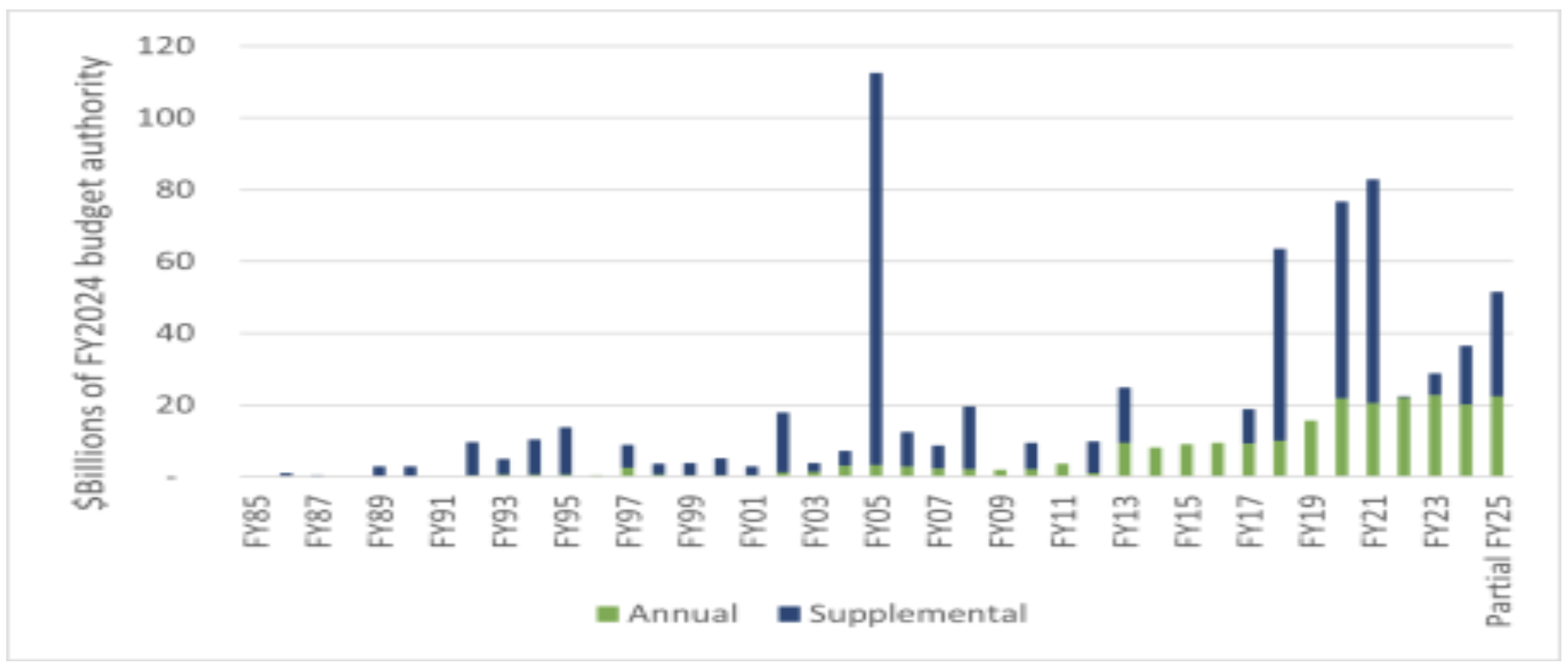
Compiled evidence details government spending on post-disaster recovery and its direct impact on the pocketbooks of Americans. SmarterSafer highlights how, in recent years, the amount of emergency disaster relief funding has increased beyond the rolling average and cost taxpayers billions of dollars. Data indicates this number will only continue to grow as the frequency and severity of natural disasters increase.
DRF Appropriations, FY1985-FY2025 (part year)
Disaster recovery affects every aspect of the U.S economy, including financial risk to the federal government. For example, if proactive steps are not taken, billions of taxpayer dollars may need to be spent on post-disaster recovery efforts in military installations due to outdated infrastructure. The country’s current infrastructure was not built to withstand the risks posed by more severe natural disasters. Data clearly shows that every $1 invested in pre-disaster mitigation saves up to $13 in federal spending. This paper serves to highlight potential pre-disaster mitigation efforts and nature-based projects that have the potential to save American taxpayers billions of dollars.
Conservation and Recreation
It’s clear that natural disasters have a profoundly negative impact on local ecosystems; less obvious, but equally important, they disrupt the economies that are supported by those ecosystems. SmarterSafer highlights potential policy solutions to support the hunting, fishing, wildlife tourism, and forestry sectors of the U.S. economy, including the need for Congressional action as natural disasters increase in frequency and severity.
Going Forward
American households face natural disasters that not only affect our communities physically, but also financially. SmarterSafer underscores the need for Congress to be proactive in efforts to preemptively combat the physical and financial devastation stemming from natural disasters by investing in and incentivizing pre-disaster mitigation and promoting public-private partnerships to offset risk to the taxpayer.
Resiliency and Pre-Disaster Mitigation: Investments that Benefit American Taxpayers
Introduction
Extreme weather events continue to take a grave toll on communities throughout the country. Flooding, wildfires, hurricanes, and tornadoes affect people across all regions and contribute to significant federal spending. From prolonged droughts disrupting agriculture to intensified inland flooding from coastal hurricanes, disasters are expanding in reach, placing more communities at risk and increasing the financial strain on taxpayers.
The consequences of severe weather extend to both microeconomic and macroeconomic stability, posing serious challenges to overall economic growth and directly affecting taxpayers. Fortunately, solutions exist that can reduce government spending while also providing greater protection for individuals who find themselves living in harm’s way. Congress must prioritize appropriate investments in resiliency and pre-disaster mitigation to secure the nation’s economic future, reduce future post-disaster expenditure, and protect communities nationwide for current and future generations.
Financial Stress from Extreme Weather Patterns and Events
Extreme weather patterns and events have escalating consequences. Climate-related disasters are not only expected to grow in intensity and destruction over time, but they are also likely to reduce economic output, which in turn lowers gross domestic product and diminishes taxable revenue. For instance, in a 2022 report, Deloitte found that leaving severe weather unmitigated, the U.S. economy is expected to contract by $14.5 trillion in the same time frame.
Implications for Taxpayers
Taxpayer Exposure
Natural disasters financially affect not only those who are physically and geographically impacted, but every single American taxpayer whose tax dollars contribute to post-disaster response and recovery efforts. In 2024, the National Oceanic and Atmospheric Administration (NOAA) estimated that the total damages from 2024 natural disasters were over $182 billion.
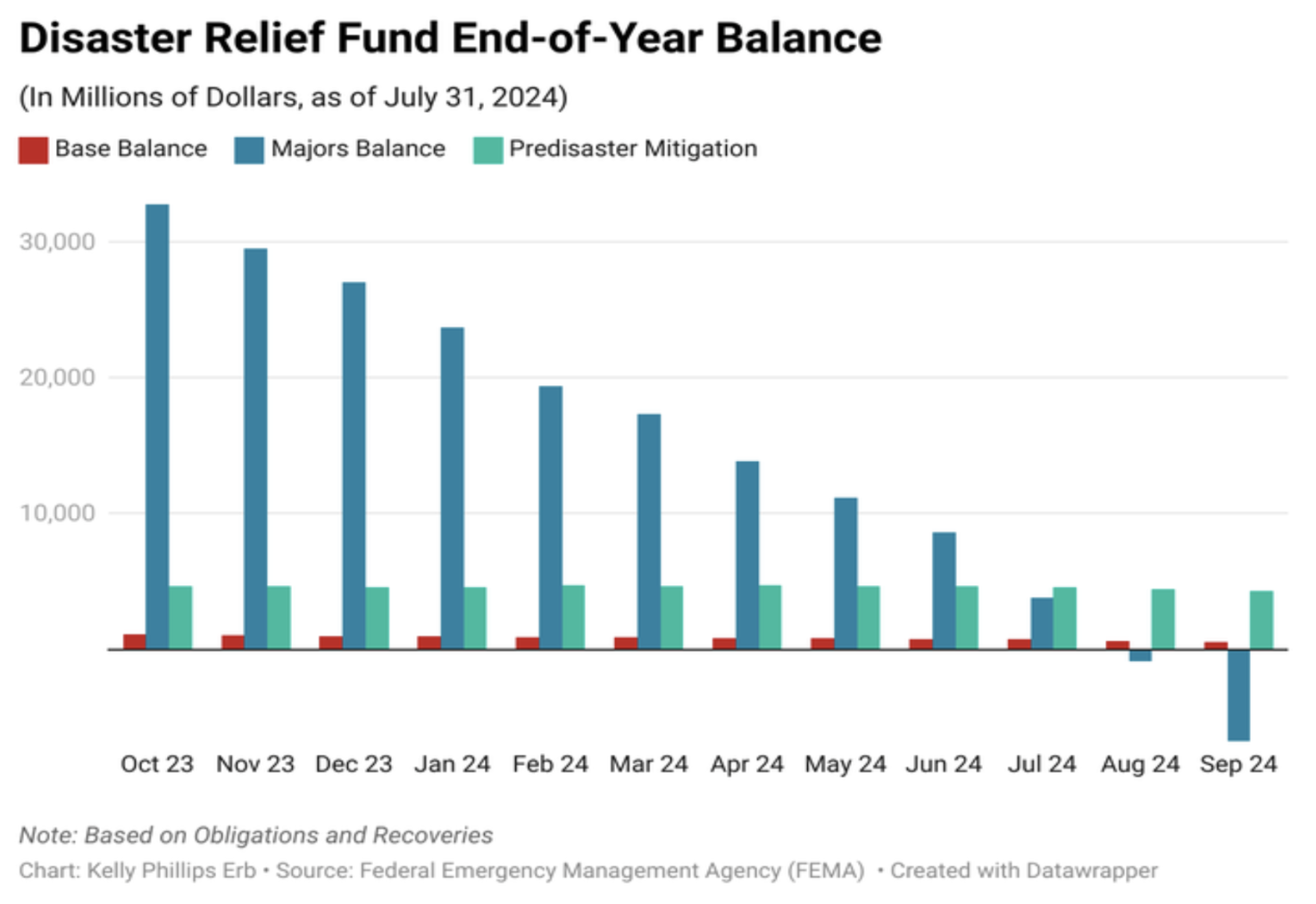
Disaster Relief Funds (DRFs) are financial resources currently managed by the Federal Emergency Management Agency (FEMA) and allocated to states facing overwhelming costs from natural disasters. While state governments maintain their own budgets to respond to extreme weather events, major disasters can quickly deplete those resources. When that happens, states often turn to Congress and federal agencies for additional support. Over time, the supplemental funding FEMA receives for DRFs has continued to grow. The chart below highlights recent DRF balances from October 2023 to September 2024.
According to NOAA, three of the top ten most costly hurricane seasons occurred during the 2020s. The 2024, 2022, and 2021 seasons ranked as the third, fourth, and sixth most expensive, respectively. In fact, the most recent season in 2024 alone resulted in a staggering $170 billion in damages.
Supplemental appropriations packages, which many Members of Congress deem necessary for short-term relief, only continue to add to the debt that American taxpayers face. The December 2024 Continuing Resolution allocated $29 billion in emergency disaster funding. The chart below highlights relatively recent spending allocated to post-disaster funding.
DRF Obligations for Major Disasters, by Program
(from Disaster Relief Fund monthly report data, as of January 10, 2024)
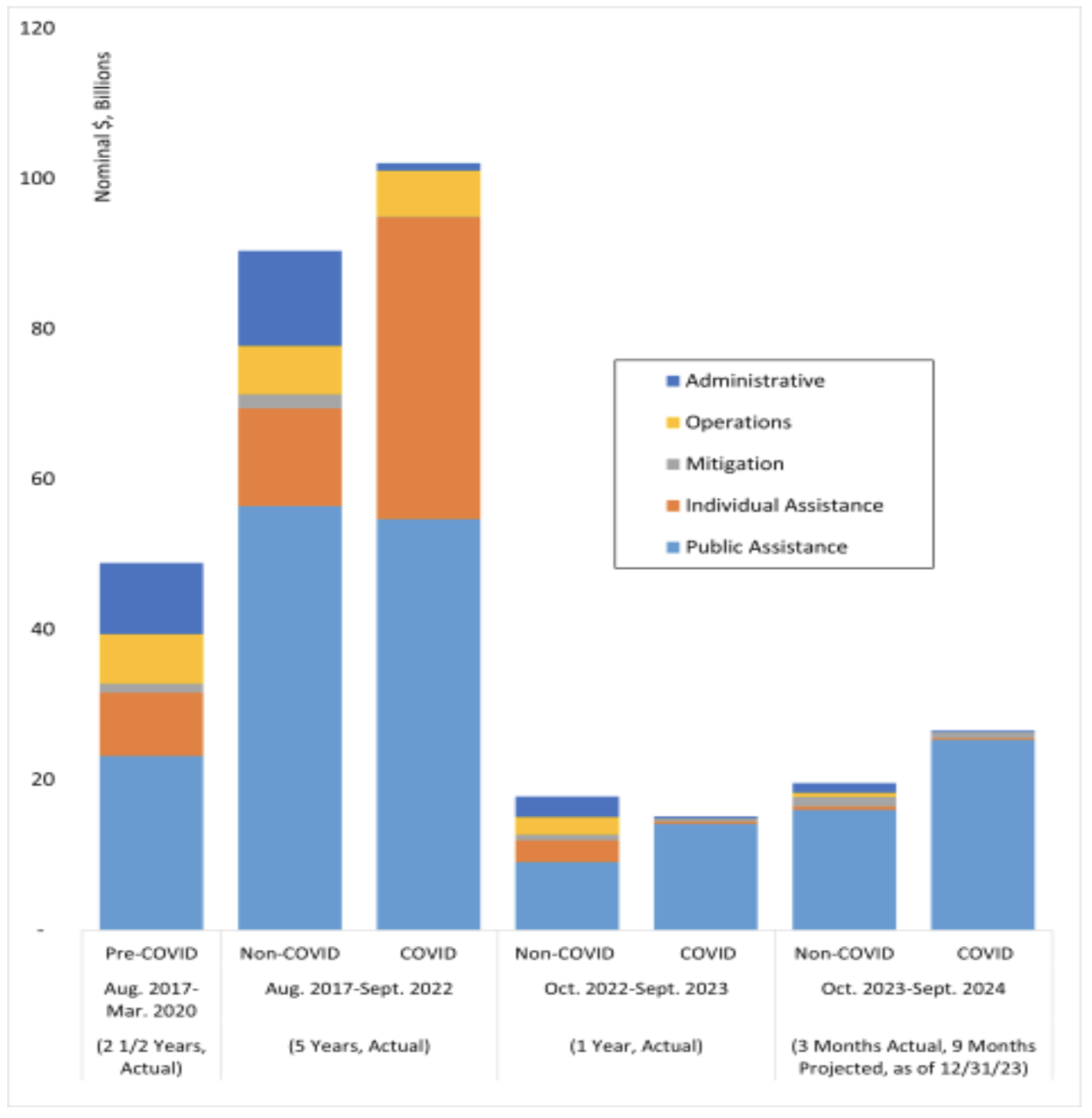
As demonstrated above, the highest levels of spending occurred during the five-year period from August 2017 to September 2022, with COVID-related costs exceeding $100 billion and non-COVID costs nearing $90 billion. Most funding appropriated by Congress to FEMA was directed toward public assistance, followed by individual assistance and operations, especially in COVID years. In contrast, funding for mitigation remained consistently small, despite its potential to reduce future disaster costs. More recent and projected spending shows a decline in total expenditures, yet the distribution remains heavily tilted toward response and recovery rather than proactive mitigation.
There is no doubt that post-disaster funding plays a critical role in helping American communities recover from the devastating impacts of natural disasters, a reality that will likely remain constant. However, it is imperative that lawmakers take a broader economic perspective and shift greater focus toward proactive investments in disaster mitigation and resilience. By prioritizing these pre-disaster measures, the nation can not only enhance community preparedness and reduce human and economic losses but also significantly cut down on the billions of taxpayer dollars currently directed toward post-disaster recovery.
National Flood Insurance Program
The National Flood Insurance Program (NFIP) serves as a critical safeguard, protecting U.S. taxpayers from floods, the most common hazard and the leading cause of economic damage, property loss, and loss of life in the United States. Still, the program is not without its challenges, which is why SmarterSafer advocates for long-term reauthorization to protect taxpayers while also recognizing the need for reforms.
As of February 2025, the NFIP sits at a staggering $22.525 billion in debt, with a borrowing authority of $7.9 billion. It has an annual shortfall of roughly $1.4 billion, as program revenues (~$4.3 billion) consistently fall short of costs (~$5.8 billion). Much of this strain stems from historically subsidized premiums that remain below actuarially sound levels, leaving the program unable to cover claims without borrowing.
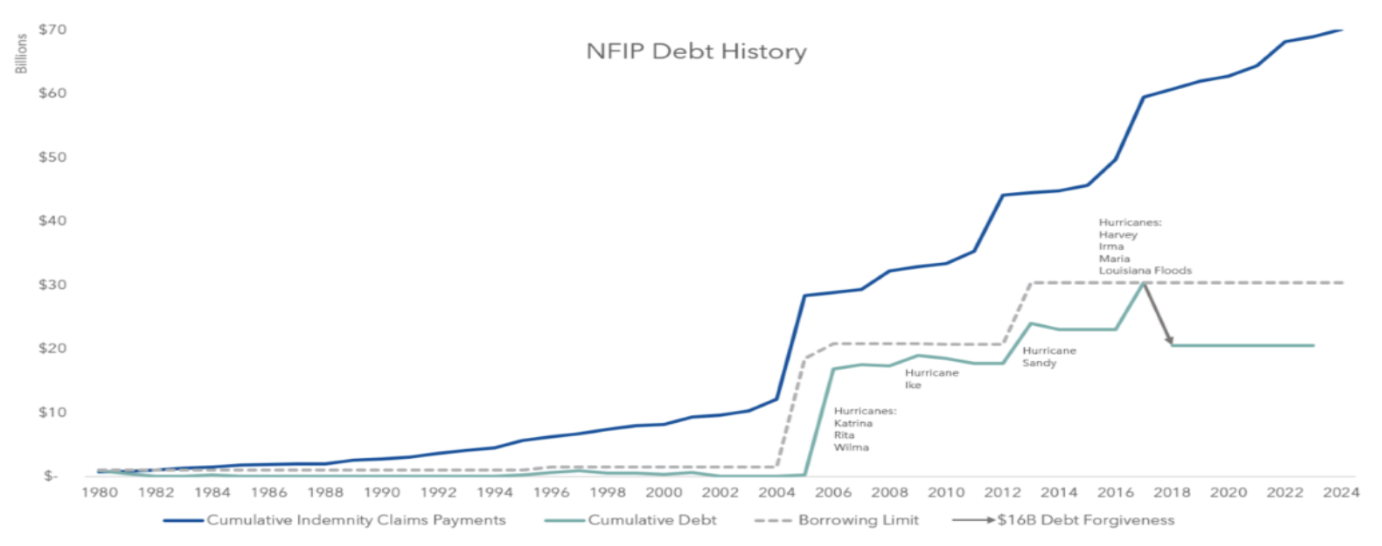
While FEMA’s Risk Rating 2.0 initiative is moving premiums toward risk-based pricing, according to the GAO, it will take until 2037 for most policies to fully reflect actual flood risk, prolonging financial instability. Structural barriers slow the growth of the private flood insurance market, and outdated maps mask actual risk, limiting both mitigation and competition in underwriting. Addressing these issues requires reforms such as phasing in full-risk premiums, replacing blanket subsidies with means-tested assistance, modernizing flood maps, and lifting restrictions that prevent policyholders from switching to private coverage. All of these measures will help slow the growth of the NFIP’s debt and protect taxpayers.
One bright spot, however, is the NFIP’s growing reliance on reinsurance and catastrophe bonds, which help shift some of the program’s risk to private markets and reduce taxpayer exposure. In recent years, FEMA has transferred between $500 million and $600 million of flood risk annually through traditional reinsurance placements, paying premiums of about $90-120 million. This risk-transfer strategy demonstrates how reinsurance can serve as a stabilizing feature in an otherwise financially troubled program, highlighting that, even as NFIP reforms are urgently needed, reinsurance stands as a rare success story in protecting both policyholders and the public purse.
Public-Private Partnerships
Public–private partnerships (PPPs) represent a critical mechanism for offsetting costs to taxpayers and scaling adaptation and resilience initiatives in the housing sector. As the Boston Consulting Group and CoreLogic, now Cotality, emphasize in a 2023 white paper, financing remains a persistent barrier, with adaptation solutions currently receiving only about one-tenth of the annual funding required globally. By combining government policy support with private-sector financial and technical capacity, PPPs can close project financing gaps, facilitate issuance of municipal bonds, and mobilize both debt and equity investment in resilience infrastructure. Beyond financing, PPPs support technical knowledge sharing, enabling local governments and community organizations to implement best practices in climate-resilient construction, flood mitigation, and disaster preparedness. Furthermore, PPPs enable coordination across jurisdictions, streamline regulatory approval processes, and ensure that adaptation projects prioritize the needs of the most vulnerable communities, addressing capital allocation biases that otherwise direct funding toward wealthier or higher-capacity regions. It also should be noted PPPs require consistent oversight and adherence to strategic plans in order to function for the benefit of taxpayers. Fortunately, the PPP concept is well-developed for vertical infrastructure (projects such as buildings, schools, hospitals, and housing), and best practices exist to avoid fiscally detrimental outcomes.
Defense Spending
Extreme weather poses risks to taxpayers beyond what may be thought of as typical disaster recovery spending, including physical risk to Department of Defense (DOD) assets, overall military readiness, and the safety of those in uniform. In April 2021, the DOD found that military bases faced a plethora of threats from extreme weather, such as wildfires from increased drought, as well as flooding for defense installations in coastal areas. This trend is consistent for bases throughout the world.
The DOD has one of the largest real estate portfolios within the federal government, with a 2023 replacement value totaling approximately $2.2 trillion. Outdated mitigation and resiliency strategies could force the federal government to spend billions of dollars reacting to disasters. Without meaningful change, this number is only expected to increase, adding extra stress to taxpayers. According to Marsh, many military housing companies face a wide range of weather-related risks, including hurricanes, wind and hailstorms, flooding, and wildfires. The geographic diversity of the properties increases exposure to different natural hazards, and the large number of properties raises the likelihood of frequent losses. These facilities and the families who live in them are more vulnerable to severe weather and other health issues that plague older buildings, such as mold and pests. Recall, Section 2832 of the FY2024 NDAA required the Secretary of Defense to establish standards for unaccompanied housing facilities regarding condition, safety and security, and “habitability, health, and environmental comfort.”
Climate adaptation and resiliency are essential to maintaining an effective military. Strengthening the durability of American military bases before storms occur will help preserve the United States’ role as the world’s leading military power.
Infrastructure Spending
The connection between infrastructure investment and disaster preparedness is critical and should not be overlooked. Much of America’s infrastructure, including roads, bridges, and stormwater systems, was built without consideration for a changing climate and is not equipped to handle the growing risks of natural disasters. Roads and bridges are deteriorating under the pressure of rising temperatures, heavier snowfall, wildfires, and severe flooding. Stormwater systems are often overwhelmed during extreme weather events. It is therefore essential that Congress, the Executive Branch, state and local governments, and other stakeholders nationwide support fiscally responsible and structurally sustainable strategies for disaster response and infrastructure policy.
Making the most of existing natural systems and investing in natural infrastructure, like restoration of wetlands, mangroves, and dunes, provides an effective solution to guarding against events like flooding, mudslides, and erosion. NOAA estimates that U.S. coastal wetlands alone provide $23.2 billion in storm protection each year. During Hurricane Sandy, for example, wetlands reduced damages by more than 22 percent in half of the areas directly affected by the storm (by as much as 30 percent in some states) and were estimated to save $625 million in direct flood damage. In addition to protecting communities, these natural features provide important wildlife habitat and will assist in creating outdoor recreation opportunities and restoring tourism activity.
A few examples of taxpayer savings and economic growth resulting from nature-based solutions include:
- Rebuild by Design and Ramboll published a business case study showing that every $1 invested in NYC’s Blue‑Green Infrastructure delivers about $2.09 in benefits, primarily from reduced flooding, sewer upgrades (20% savings), avoided damage, and improved quality of life. 82% of the city saw a positive benefit-cost case.
- Along the Gulf Coast, the estimated benefit-cost ratio of wetland restoration for flood risk reduction is 8:1, compared with only 0.99:1 for local levees in high-risk areas.
- In 2024, an additional $8 million FEMA grant brought total funding to nearly $250 million for the Bee Branch Watershed Flood Mitigation Project in Dubuque, Mississippi. The full project is expected to prevent about $582 million in damages over its ~100-year design lifetime.
- The installation of 28 rain gardens in Aurora, Illinois, has provided a buffer for the city’s storm sewer system and saved the city an estimated $1.8 million.
Taxpayer Protection
As the costs of disasters continue to rise, it becomes more evident that a post-disaster approach to natural catastrophes is simply not sustainable or friendly to American taxpayers. Research shows that every dollar invested in pre-disaster mitigation saves up to $13 in federal spending. The federal government cannot continue to allocate the majority of risk reduction funding after damage has been inflicted when pre-disaster mitigation and resiliency efforts have repeatedly proven to be more effective and save millions in taxpayer money. Investments in resiliency and pre-disaster mitigation are the best strategy to safeguard taxpayers’ dollars while offering strong protections to vulnerable local communities.
Conservation and Recreation
Extreme weather events also have serious consequences for conservation efforts. The ongoing guardianship of wetlands and forests has been made more challenging by increasingly destructive weather. Additionally, the recreation industry has suffered major losses caused by natural disasters across the country. In response, several conservation organizations have launched campaigns to draw attention to the damage recent extreme weather has caused within their respective sectors.
Ducks Unlimited (DU), a leading organization in wetland conservation, has been increasingly focused on the effects of extreme weather events on waterfowl breeding habitats. According to DU, “Most major waterfowl habitats in North America face potentially significant, detrimental impacts from the effects of climate change. Historic waterfowl breeding grounds such as the Prairie Pothole Region and Western Boreal Forest could experience significant landscape changes and face more variable weather and precipitation, which could result in diminished waterfowl breeding populations in these areas over the long term.” DU also emphasized how extreme weather patterns are affecting California, stating, “The Central Valley of California, a key wintering area for pintails and other Pacific Flyway waterfowl, could see changes in water availability that will also impact waterfowl habitat abundance.” In response, DU and other conservation organizations have increased their investment in research and outreach to better understand and communicate how severe weather is influencing conservation priorities.
The Congressional Sportsmen’s Foundation (CSF), a nonprofit dedicated to collaborating with lawmakers to support and promote hunting, angling, and recreational shooting, has increasingly turned its attention to climate change, severe weather, and its effects on various outdoor recreation sectors. They state that addressing severe weather requires targeted, science-based conservation practices that maintain access to hunting, fishing, and other outdoor traditions. They argue that solutions should focus on restoring habitats, enhancing biodiversity, and supporting active land and forest management rather than passive preservation. In the past, they have. They supported initiatives like the 30 by 30 plan and the “Recovering America’s Wildlife Act, introduced in the 118th Congress but emphasize the need for local control, stakeholder engagement, and recognition of existing conservation efforts.
Policy Solutions
The most effective approach to safeguarding communities and making efficient use of taxpayer dollars is to prioritize and invest in pre-disaster mitigation and support measures promoting resiliency. This concept is well known in Congress, where lawmakers from both parties have introduced legislation supporting mitigation and resilience initiatives.
SmarterSafer recently published its 2025 priorities list. The list provides recommendations to the administration and Congress, outlining effective policy solutions that can help save lives and alleviate the financial pressure on taxpayers’ wallets. We note some key priorities here:
- Promote Mitigation Measures – Mitigation is the best long-term defense against flooding. An NFIP reauthorization package and others should include language that authorizes the necessary funding to improve mitigation measures in areas susceptible to flooding and should place a particular emphasis on nature-based and resilient infrastructure.
- Improved Resiliency Measures – Congress should focus on ensuring that federally-funded projects account for future flood risks by incorporating resiliency and mitigation measures in their planning. Any NFIP reauthorization package should include requirements for regularly updated data and mapping to accurately assess flood risks, while also recognizing communities that have made investments in resilient infrastructure and flood mitigation.
- Updated Mapping – Any NFIP reauthorization package should include measures that allocate funds to assist with updating floodplain mapping in areas susceptible to flooding. Legislation that accelerates the generation of new and modern maps, including through the use of best-available technology, will help communities better identify and communicate present and future risks. Communities impacted by flooding must be better informed of accurate levels of risk in order to plan for future disasters.
- NFIP Minimum Building Criteria – Congress and the administration should support efforts to require smarter building criteria to reduce flood risk, such as higher elevation standards in the special flood hazard area, incorporating standards to safely site and design critical infrastructure, encourage the retention of natural floodplain buffers, and remove incentives for ongoing fill and build practices.
- Incentivize Community Preparation Activities – Policymakers should create incentives to encourage state, local, and Tribal governments to improve land use planning, adopt and enforce building codes, and utilize code-plus designs such as the IBHS FORTIFIED program, while increasing the accessibility of federal grants for wildfire risk reduction efforts. Additionally, they should incentivize innovation in affordable building material design, subdivision design, landscape architecture, and safe, sustainable building practices to create more ignition-resistant structures and communities.
- Promoting Climate-Resilient Infrastructure – SmarterSafer advocates for the promotion of the development of climate-resilient infrastructure based on vulnerability assessments using high-quality information and data. This includes programs like the Department of Transportation’s PROTECT grants, as well as FEMA’s BRIC– a critical source of pre-disaster mitigation funds.
- Community Wildfire Risk Reduction Program – Establishing an interagency coordinating partnership would reduce friction between programs, align federal efforts, and strengthen ignition resistance of homes and communities. This gets at the heart of proactive wildfire risk reduction.
- Improve Hazard Assessments – Strengthening data systems to guide building codes, defensible space, and ignition-resistant construction is crucial for science-based, long-term wildfire resilience.
- Facilitate Prescribed Burning – Scaling up prescribed fire nationally, while ensuring liability protections and regulatory flexibility, is one of the most effective tools for reducing wildfire severity.
- Support Local Implementation of Preparedness Measures – Creating incentives for land use planning, building practices, and accessible grants ensures that state, local, and Tribal governments can implement resilience measures on the ground.
Conclusion
Building an economy that can withstand increasingly severe weather events is an ongoing and indefinite endeavor. When disasters strike, they can devastate entire communities, erase generations of progress, and destroy essential infrastructure such as homes, schools, hospitals, and roads. While this paper primarily focuses on the financial dimensions of extreme weather, it is important not to overlook the profound human and emotional toll that natural disasters cause. The loss of community bonds and lives cannot be measured. To address these challenges, Congress must take a proactive approach by investing in and incentivizing appropriate pre-disaster mitigation, ensuring that aid is delivered quickly and fairly, as well as encouraging public-private partnerships to reduce the financial burden on taxpayers. These actions are necessary to begin building the resilient communities and economies of the future.