
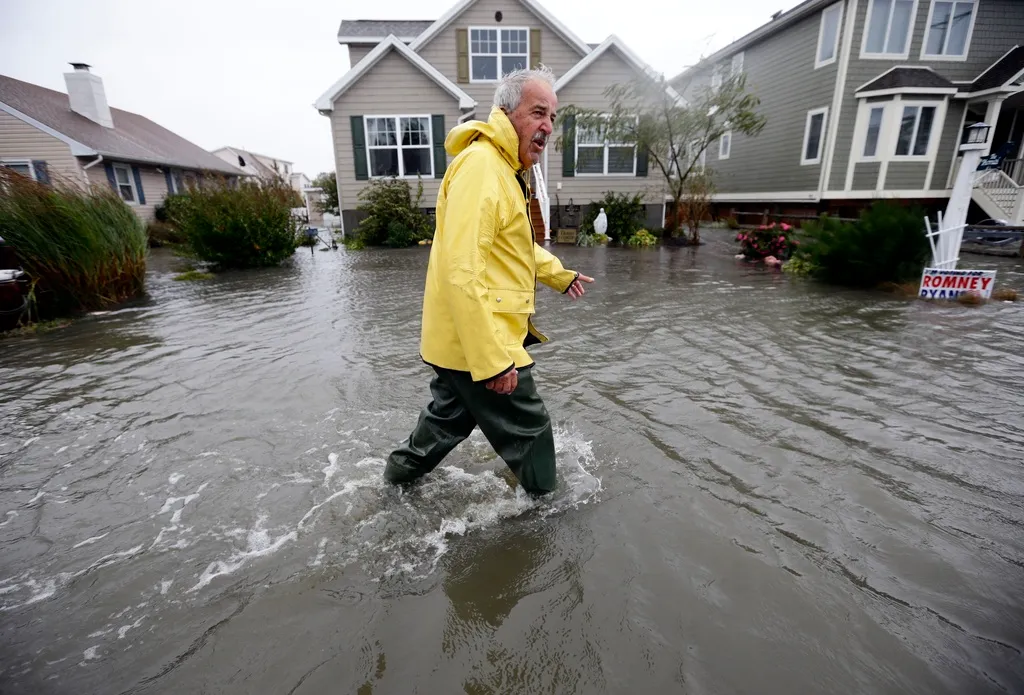
Richard Thomas walks through the floodwaters in front of his home after assisting neighbors as Hurricane Sandy bears down on the East Coast, Monday, Oct. 29, 2012, in Fenwick Island, Del. (AP Photo/Alex Brandon, File)
Federal disaster spending has become one of Washington’s fastest-growing budget obligations. The next decade will test America’s ability to withstand stronger storms, rising temperatures and more frequent wildfires. Fortunately for policymakers and city planning officials, investments in pre-disaster mitigation are not only proven to protect communities but can save billions in taxpayer dollars.
Natural disasters don’t just hit the communities in harm’s way; whether they’re in the disaster zone or are thousands of miles across the country, they affect every American taxpayer. When natural disasters strike, federal dollars are used to assist states’ rebuilding efforts. In 2024 alone, the National Oceanic and Atmospheric Administration estimated that natural disasters caused over $182 billion in damage nationwide.
There is, however, an opportunity to reduce federal disaster expenditure by taking a more proactive approach to disaster mitigation.
Investments in pre-disaster mitigation have been demonstrably effective. According to the National Institute of Building Sciences, elevating infrastructure can save more than $12 for every $1 spent. During Hurricane Sandy, for example, investments in natural infrastructure like wetlands reduced damages by more than 22 percent in half of the areas directly affected by the storm. This proactive investment in pre-disaster mitigation is estimated to have saved $625 million in direct flood damage.
For American taxpayers, every year of inaction means higher recovery spending, greater infrastructure losses and more strain on federal budgets.
As highlighted in the SmarterSafer Coalition’s recent white paper, Resiliency and Pre-Disaster Mitigation: Investments that Benefit American Taxpayers, “Investments in resiliency and pre-disaster mitigation are the best strategy to safeguard taxpayers’ dollars while offering strong protections to vulnerable local communities.”
The paper discusses the short and long-term value of measures like strengthening federal support for hazard mitigation programs. For example, a long-term reauthorization of the National Flood Insurance Program can facilitate funding for necessary mitigation measures in flood-prone areas, which could save taxpayers millions of dollars.
Disaster spending can also be curbed by ensuring that federally funded projects are built with future risk in mind, requiring up-to-date flood mapping and incentives for communities that have already invested in resilient infrastructure.
Additionally, public-private partnerships can help deploy proven resilience measures more widely, providing capital and innovation into projects at a scale the government alone cannot achieve. For example, an AI tool recently developed by Google in collaboration with the National Hurricane Center is already revolutionizing disaster prediction. Technological innovation is reshaping the possibilities for disaster prevention, and public-private partnerships can provide the means to harness it.
As disaster costs climb year after year, the vicious cycle of destruction and recovery is neither sustainable nor fiscally responsible.
Stronger mitigation and smarter planning won’t eliminate disasters but will make them far less costly for communities and taxpayers alike. When federal policy prioritizes resilience, states and cities are able to plan ahead, strengthen vulnerable neighborhoods, and avoid the repeated budget shocks that often accompany natural disasters.
As disasters become more frequent and intense, we must invest before the damage occurs rather than shoulder the high cost of recovery year over year. A mitigation-first approach provides a practical strategy for safeguarding lives and saving tax dollars nationwide
Chris Brown is the executive director of the SmarterSafer Coalition, which brings together a wide range of environmental groups, consumer and tax advocates, insurance professionals and housing stakeholders in support of environmentally responsible, fiscally sound approaches to natural catastrophe policy that promote public safety.